Introduction
Warehouse automation is no longer a future-state investment, it’s a present-day necessity. Rising labor costs, workforce shortages, and increasing customer expectations have forced operators to rethink how work gets done inside the four walls.
But automation isn’t just about deploying robots or installing conveyors. The most successful warehouses follow a clear automation strategy—one that aligns technology with operational goals, constraints, and growth plans.
This guide breaks down the core warehouse automation strategies used by leading operators today, including when to automate, what technologies to consider, and how to maximize ROI.
What Is Warehouse Automation?
Warehouse automation refers to the use of technology to reduce or eliminate manual labor in tasks such as picking, transporting, sorting, and inventory management.
Automation can range from simple tools (like barcode scanning and pick-to-light systems) to advanced systems such as:
- Autonomous Mobile Robots (AMRs)
- Automated Guided Vehicles (AGVs)
- Automated Storage and Retrieval Systems (AS/RS)
- Conveyor and sortation systems
- Warehouse orchestration software
The goal is not just to replace labor, but to increase throughput, accuracy, and operational flexibility.
Types of Warehouse Automation Technologies
Autonomous Mobile Robots (AMRs):
AMRs navigate dynamically through a warehouse to move goods, assist with picking, and reduce travel time.
Best for: Flexible environments, eCommerce, dynamic workflows
Automated Guided Vehicles (AGVs)
AGVs follow fixed paths or markers to transport materials.
Best for: Predictable, repetitive workflows
Automated Storage and Retrieval Systems (AS/RS)
High-density storage systems that automatically store and retrieve goods.
Best for: Space optimization, greenfield sites, high-volume operations
Conveyor and Sortation Systems
Move goods along fixed paths for sorting and distribution.
Best for: High-throughput, standardized processes
When Should You Automate Your Warehouse?
Not every warehouse benefits from automation at the same time. Key signals that indicate readiness include:
- Labor costs exceeding 50–70% of operational expenses
- Difficulty hiring or retaining workers
- Increasing order volumes or SKU complexity
- Bottlenecks in picking, packing, or transport
- Frequent errors or missed SLAs
A useful rule of thumb: if growth is constrained by labor or throughput (not demand), automation should be evaluated.
Warehouse Automation Strategies by Maturity Stage
Stage 1: Task-Level Automation
Focus on automating specific high-friction tasks.
Examples:
- Pick-to-light systems
- Mobile robots assisting pickers
- Basic workflow digitization
Goal: Reduce manual effort and improve accuracy
Stage 2: Workflow Optimization
Combine multiple automation systems to improve end-to-end processes.
Examples:
- Integrating AMRs with WMS
- Introducing conveyor systems for transport
- Optimizing picking paths
Goal: Increase throughput and reduce bottlenecks
Stage 3: Orchestrated Automation
Use orchestration software to dynamically coordinate all resources.
Examples:
- Real-time task allocation between humans and robots
- Adaptive workflows based on demand
- Multi-system coordination (robots, conveyors, storage)
Goal: Maximize efficiency, flexibility, and scalability
Common Warehouse Automation Mistakes
Over-Automating Too Early
Investing in rigid systems before understanding workflows can limit flexibility.
Ignoring Process Optimization
Automation amplifies inefficiencies if processes are not optimized first.
Choosing Technology Over Strategy
Technology should support business goals—not define them.
Underestimating Change Management
Successful automation requires training, adoption, and operational alignment.
Warehouse Automation ROI Benchmarks
While ROI varies by operation, typical benchmarks include:
- 20–50% reduction in labor costs
- 2–3x increase in throughput
- 99%+ order accuracy
- 12–24 month payback period
ROI depends heavily on:
- scale of deployment
- operational complexity
- integration with existing systems
How to Build a Warehouse Automation Strategy
To develop an effective strategy:
- Assess current operations
- Identify bottlenecks and cost drivers
- Define business objectives
- Throughput, cost reduction, scalability
- Evaluate automation options
- Match technology to use cases
- Commit to a scalable, site-level strategy
- Design for full operational integration from the outset
- Align ownership and execution
- Ensure clear accountability across operations, IT, and leadership
Why “Start Small” Can Backfire
While many automation strategies recommend piloting before scaling, this approach can introduce significant risk in complex warehouse environments.
Fear of Disruption Slows Real Progress
Small projects are often chosen to minimize disruption—but this can delay meaningful transformation. In practice, the risk of falling behind competitors often outweighs the risk of change.
Legacy Processes Limit Impact
Most warehouse processes are optimized for manual labor, not automation. Small deployments typically layer automation onto existing workflows instead of redesigning them—limiting potential gains.
Fragmented Ownership and Investment
Limited-scope projects often result in:
- unclear ownership across teams
- underinvestment at the site level
- disconnected systems that don’t scale
Lack of Full Integration
Automation delivers the most value when systems are fully integrated across workflows. Partial deployments can create bottlenecks rather than eliminate them.
Signals a Weak Automation Strategy
A reliance on small pilots can indicate that the broader automation strategy is underdeveloped or misaligned with long-term operational goals.
In many cases, leading operators take a different approach: They design automation strategies at the system level from the beginning—aligning technology, processes, and organizational ownership to support long-term scale.
The Orchestrated Automation Model
Definition: The Orchestrated Automation Model is a system-level approach to warehouse automation that coordinates people, robots, and software into a unified, adaptive operation designed for scale, efficiency, and continuous optimization.
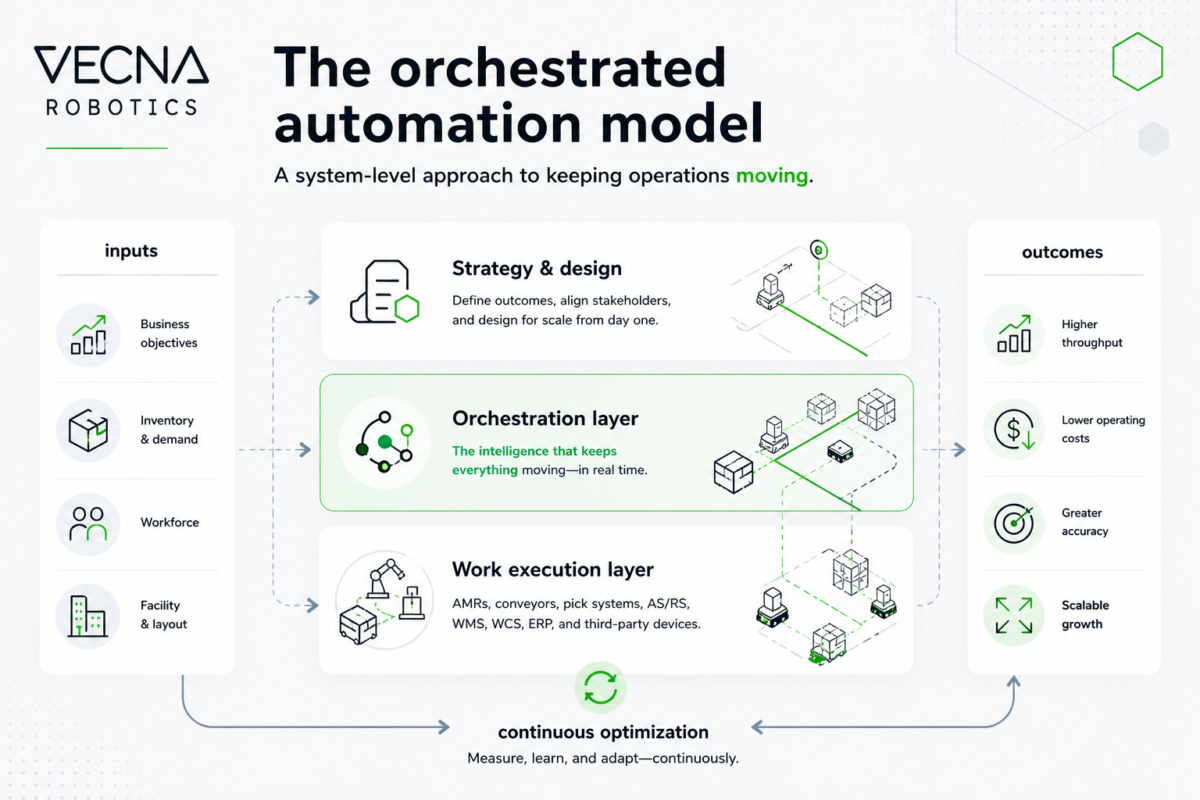
To move beyond fragmented pilots and unlock full operational impact, leading organizations follow a Orchestrated Automation Model. This approach treats automation as an integrated, site-wide capability—not a collection of isolated projects.
Define System Objectives
- Establish clear, measurable goals at the site level (e.g., throughput targets, labor reduction, SLA performance)
- Align automation initiatives with business outcomes—not individual tasks
Redesign Workflows for Automation
- Re-architect processes assuming automation is the default, not an add-on
- Eliminate legacy, labor-optimized steps that constrain performance
Select Interoperable Technologies
- Choose systems (AMRs, AS/RS, conveyors, software) that can integrate and scale together
- Prioritize flexibility and adaptability over rigid point solutions
Orchestrate Across Systems
- Implement orchestration to coordinate humans, robots, and infrastructure in real time
- Enable dynamic task allocation and continuous optimization
Establish Clear Ownership
- Assign cross-functional accountability (operations, IT, engineering)
- Ensure decision-making authority aligns with system-level outcomes
Deploy at System Scale
- Implement automation in a way that impacts core workflows—not edge cases
- Avoid fragmented rollouts that create new bottlenecks
Continuously Optimize
- Use data and operational feedback to refine performance over time
- Treat automation as an evolving capability, not a one-time deployment
Why This Framework Matters
Organizations that adopt an orchestrated automation approach consistently achieve:
- higher ROI from automation investments
- faster time to operational impact
- greater flexibility in handling demand variability
By contrast, fragmented or incremental approaches often lead to underperformance, integration challenges, and missed opportunities for transformation.
Conclusion
Warehouse automation is not a side project. It’s an operating model.
The difference between incremental gains and step-change performance comes down to how you approach it. Fragmented deployments and cautious pilots often preserve the status quo. System-level thinking changes it.
The Orchestrated Automation Model is built for that shift. It aligns strategy, redesigns workflows for automation from the start, and connects people, robots, and systems through real-time orchestration—so the entire operation moves as one.
When you design for orchestration at scale, you don’t just automate tasks—you unlock capacity, eliminate constraints, and create an operation that adapts as demand changes.
That’s how leading operators are moving forward:
- designing for full integration, not isolated wins
- prioritizing flow and coordination over point solutions
- building systems that improve continuously, not just once
The opportunity isn’t to automate more. It’s to operate differently. And for organizations ready to make that shift, the path is clear: Orchestrate. Optimize. Outperform.