Introduction
Most warehouse automation strategies focus on the tools: robots, conveyors, storage systems. But adding more technology doesn’t automatically create a better operation.
Many warehouses end up with islands of automation—systems that perform well individually but fail to work together. The result is familiar: bottlenecks shift, labor is still required to bridge gaps, and performance plateaus. The missing piece isn’t another system. It’s orchestration.
What Is Warehouse Orchestration?
Warehouse orchestration is the coordination of people, robots, and systems in real time to ensure work flows efficiently across the entire operation. Instead of managing tasks in isolation, orchestration manages how work moves. It can dynamically assign tasks based on current conditions, balance workloads across resources, adapt to disruptions or demand changes, and ensure continuous flow from start to finish. In simple terms, automation executes tasks and orchestration makes sure those tasks happen at the right time, in the right place, by the right resource.
Why Automation Alone Isn’t Enough
Automation improves specific parts of a warehouse. But without coordination, it can introduce new inefficiencies. Common issues include:
- Robots waiting for work while operators are overloaded
- Conveyors creating downstream congestion
- Systems operating on static rules that don’t reflect real-time conditions
- Manual intervention required to keep things moving
Each system may be optimized, but the operation as a whole is not. Efficiency doesn’t come from isolated performance, it comes from coordinated flow.
Orchestration vs WMS: What’s the Difference?
A Warehouse Management System (WMS) is designed to track inventory and manage orders. Orchestration operates at a different level.
WMS:
- manages inventory and transactions
- plans tasks based on predefined logic
- operates on scheduled or batch processes
Orchestration:
- coordinates execution across systems
- makes real-time decisions
- dynamically adjusts to changing conditions
Think of it this way: The WMS tells the warehouse what needs to be done. Orchestration determines how it gets done most efficiently.
How Warehouse Orchestration Works
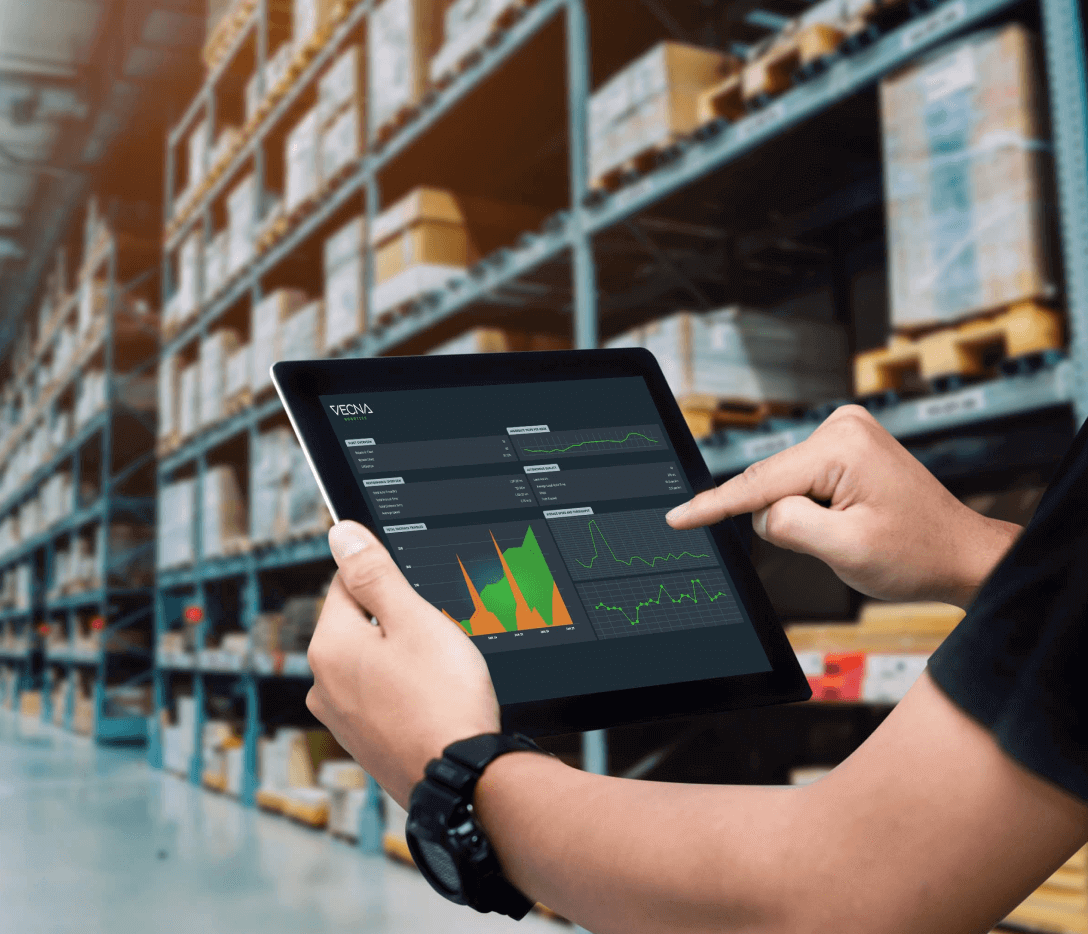
At its core, orchestration acts as a control layer across the operation. It continuously evaluates order demand, inventory location, resource availability (people, robots, equipment), and the state of the facility itself—from system availability to physical constraints like access points and flow paths. It then makes real-time decisions about which tasks to prioritize, which resources should execute them, and how work should move through the system. This happens continuously, not in static waves or predefined paths. The result is an operation that responds to real conditions, not assumptions.
Key Benefits of Warehouse Orchestration
Reduced labor requirements
By eliminating idle time, unnecessary movement, and manual coordination, orchestration reduces the total amount of labor required to move goods.
Increased throughput
Work flows continuously instead of stopping and starting between systems, enabling higher output without expanding the facility.
Greater flexibility
Operations can adapt to changes in demand, staffing, or disruptions without requiring manual intervention.
Better utilization of automation
Robots and systems are used more effectively when they are coordinated as part of a larger workflow.
Improved consistency and accuracy
Real-time coordination reduces errors caused by misalignment between systems and processes.
Where Orchestration Delivers the Most Value
Orchestration is most impactful in environments where:
- workflows are complex or dynamic
- labor availability fluctuates
- demand varies significantly
- congestion is aisles is delaying task completion
- environments with diverse or multi-vendor automation systems
Typical use cases include:
- mixed human-robot operations
- high-volume eCommerce fulfillment
- multi-zone picking environments
- facilities scaling rapidly
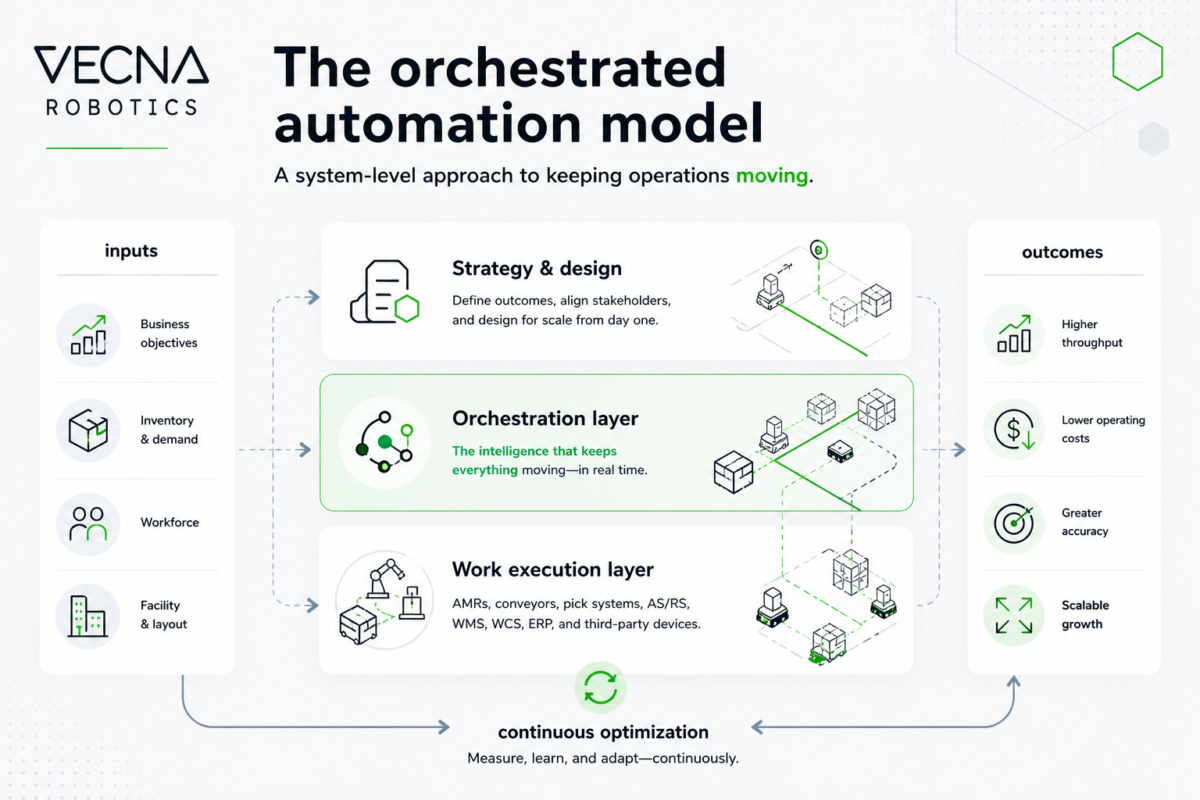
The Orchestrated Automation Model
The most effective warehouses don’t treat orchestration as an add-on. They design operations around it. The Orchestrated Automation Model is a system-level approach that aligns strategy with execution, redesigns workflows for automation from the start, and connects people, robots, and systems through a unified control layer. In this model automation handles execution, orchestration ensures coordination, and data drives continuous improvement. This creates an operation where everything works together—not just side by side.
Common Mistakes to Avoid
Treating orchestration as a feature
Orchestration is not a single capability—it’s an operating model. Treating it as a feature limits its impact.
Layering orchestration onto broken processes
If workflows are not redesigned, orchestration will only optimize existing inefficiencies.
Relying on static rules
True orchestration requires real-time adaptability, not fixed logic.
Underestimating integration
Orchestration depends on seamless communication between systems. Without integration, coordination breaks down.
The Future of Warehouse Operations
Warehouse operations are moving toward systems that are more autonomous, more adaptive, and more interconnected. Orchestration is what enables this shift, but it’s still early. Today, many operations are only partially orchestrated. Systems may coordinate within a single vendor’s ecosystem, but true interoperability across technologies is still evolving.
Looking ahead, orchestration should expand to:
- Multi-vendor robot coordination — enabling robots from different providers to work together seamlessly within the same workflows
- Facility-level integration — connecting automation to physical infrastructure such as doors, elevators, conveyors, and safety systems
- End-to-end workflow visibility — coordinating across inbound, storage, picking, and outbound without silos
- Smarter environmental interaction — systems that respond dynamically to real-world conditions, not just digital inputs
As these capabilities mature, orchestration will move beyond coordinating tasks to coordinating entire environments. The operations that invest early in flexible, interoperable systems will be best positioned to take advantage of this shift.
Conclusion
Warehouse automation has evolved, but without orchestration, its impact is limited. The next phase of operational performance isn’t about adding more systems. It’s about making them work together. Orchestration turns automation into a coordinated, responsive system that reduces labor, increases throughput, and adapts to change. It’s not just another layer of technology. It’s the difference between automation that operates and automation that performs.