Warehouse leaders evaluating robotic case picking solutions often focus on throughput, AI capabilities, or picking accuracy first. But one of the most important factors impacting long-term operational success is often overlooked: The robot’s form factor.
Specifically, whether the system is designed around a traditional “deck-loader” architecture or a pallet jack-style design. While both approaches automate case movement, they create dramatically different infrastructure requirements, deployment timelines, operational constraints, and labor impacts. For many warehouses, the difference determines whether automation becomes scalable or operationally disruptive.
Infrastructure-Heavy vs. Warehouse-Native Automation
Warehouse automation is increasingly shifting toward flexible systems that minimize infrastructure dependency and integrate naturally into existing operations.
Historically, many case picking solutions relied on:
- Fixed robotic cells
- Conveyor-heavy infrastructure
- Specialized loading workflows
- Deck-loader architectures
- Dedicated automation zones
These systems can automate specific workflows effectively, especially in human-to-robot picking environments where operators pick directly onto robotic platforms. However, they often require warehouses to redesign portions of their facility, pallet flow, staging processes, and operational workflows around the automation itself.
Today, many operators are prioritizing warehouse-native automation approaches that require fewer infrastructure changes, scale incrementally, preserve operational flexibility, integrate into existing workflows, and minimize deployment disruption. CaseFlow’s pallet jack form factor was designed specifically for this operational reality.
What Is a Deck-Loader Case Picking System?
Many automated case picking systems (particularly workflows where human pickers pick cases directly onto autonomous mobile robots (AMRs) or robotic transport platforms) use a deck-loader form factor. These systems typically approach pallets or load surfaces from a fixed orientation and require cases to be presented in a specific way for robotic access and transport.
In practice, this often introduces additional operational dependencies, including dedicated loading and staging zones, specialized pallet transfer workflows, conveyor integration, lift or elevation systems, modified pallet presentation standards, wider automation aisles, and additional operator training or handoff procedures. These systems can deliver automation value, but they frequently require warehouses to redesign portions of their facility and operational flow around the automation itself.
That creates a common challenge for distribution operations: the warehouse must adapt to the robot.
By contrast, warehouse-native automation approaches are designed to operate within the workflows, layouts, and pallet movement patterns warehouses already use every day.
The Hidden Cost of Infrastructure-Heavy Automation
Infrastructure-heavy automation projects often look manageable during planning phases but become significantly more complex during deployment. Warehouse operators quickly discover that introducing specialized workflows impacts much more than the picking process alone. Even relatively small infrastructure modifications can increase deployment timelines, create operational downtime, and reduce flexibility when workflows change seasonally. This is particularly important in modern distribution environments where facilities must continuously adapt to:
- SKU growth
- Seasonal variability
- Labor fluctuations
- E-commerce demand shifts
- Customer-specific workflows
- Mixed pallet profiles
The more rigid the automation infrastructure becomes, the harder it is for operations teams to maintain flexibility.
Why Pallet Jack Form Factors Matter
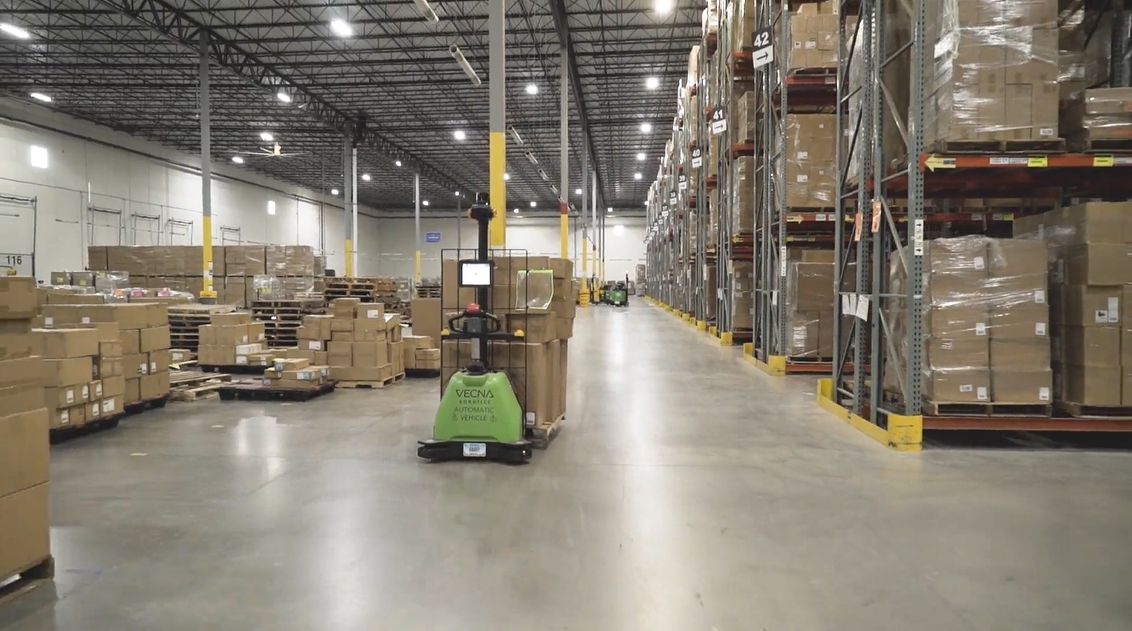
Pallet jack-based robotic systems take a fundamentally different approach. Instead of forcing the warehouse to redesign workflows around the robot, the automation is designed to operate within existing warehouse processes. A pallet jack form factor allows robots to move naturally within warehouse traffic patterns, work with standard pallet presentation, operate in existing aisle structures, integrate into familiar operator workflows, reduce dependency on fixed automation infrastructure, and scale without major facility redesigns.
Compared to infrastructure-heavy automation approaches, pallet jack-style robotics can significantly reduce operational disruption during deployment. Additionally, the pallet jack form factor enables a strong balance between flexibility and payload handling capability.
Many highly flexible mobile robotic systems sacrifice payload stability, pallet compatibility, or throughput efficiency. CaseFlow’s pallet jack-based architecture is designed to maintain operational flexibility while still supporting warehouse-scale pallet and case handling workflows.
At the same time, every mobile automation architecture involves tradeoffs. Some pallet jack-style robotic systems can face limitations around payload stability and environmental conditions if not purpose-built for warehouse-scale operations. These considerations make robotic design, load handling stability, and warehouse compatibility critically important when evaluating flexible automation systems. The goal is not simply mobility, it is achieving warehouse-scale performance without introducing infrastructure-heavy complexity.
Payload and Infrastructure Comparison
| Infrastructure-Heavy Deck-Loader Systems | CaseFlow Pallet Jack Form Factor |
|---|---|
| Requires dedicated loading infrastructure | Uses existing pallet workflows |
| Often depends on conveyors or staging zones | Minimal infrastructure changes |
| Specialized pallet presentation | Standard pallet presentation |
| Larger automation footprint | Compact warehouse-native footprint |
| More workflow redesign | Preserves existing operational flow |
| Higher deployment complexity | Faster deployment and adoption |
| Infrastructure scaling costs | Flexible incremental scaling |
| Additional operator retraining | Familiar pallet jack-style operation |
Form factor directly influences how quickly automation can be adopted on the warehouse floor. When a robot operates more like equipment teams already understand, it reduces the learning curve for operators, supervisors, maintenance teams, and safety teams. The workflow feels familiar. The footprint fits existing traffic patterns. The interaction model aligns with how pallets already move through the facility.
That familiarity lowers operational friction during deployment. Instead of asking teams to learn an entirely new process or redesign the flow of work around a specialized machine, pallet jack-style automation can fit more naturally into day-to-day warehouse operations.
CaseFlow’s Warehouse-Native Approach
CaseFlow was designed around a pallet jack form factor specifically to reduce operational disruption and infrastructure dependency. Rather than requiring specialized pallet loading systems or dedicated automation zones, CaseFlow integrates directly into existing warehouse operations. This creates several major advantages for warehouse operators.
Faster Deployment
Because facilities do not need significant redesigns, CaseFlow deployments can move faster with fewer operational interruptions.
Warehouses avoid:
- Large-scale conveyor additions
- Dedicated robotic loading infrastructure
- Extensive facility retrofits
- Complex upstream workflow modifications
That reduces both deployment time and project risk.
Lower Infrastructure Costs
Infrastructure often becomes one of the largest hidden costs in automation projects. By minimizing facility modifications, CaseFlow helps operations avoid large capital expenditures tied to:
- Structural changes
- Conveyor systems
- Staging redesigns
- Electrical expansion
- Additional automation transfer points
This improves the overall economics of automation adoption.
Easier Operational Adoption
Operators already understand pallet jack workflows. That reduces training complexity and simplifies change management across warehouse teams. Instead of introducing entirely new movement patterns or operational processes, CaseFlow aligns with existing warehouse behavior. That can accelerate workforce adoption while reducing operational resistance.
Greater Flexibility
Warehouses are dynamic environments. Layouts change. SKU profiles evolve. Volumes fluctuate. Customer requirements shift. A pallet jack-based architecture gives operations teams more flexibility to adapt without rebuilding infrastructure around fixed automation constraints.
Why This Matters for Warehouse Scalability
The long-term success of warehouse automation is not determined solely by robotic performance. It is determined by how easily automation can scale operationally. Highly specialized automation systems often become difficult to replicate across facilities because each deployment requires significant customization.
In contrast, warehouse-native automation approaches are easier to:
- Deploy across multiple sites
- Adapt to existing layouts
- Integrate into varied workflows
- Scale incrementally
- Expand alongside operational growth
This is becoming increasingly important as distribution networks prioritize flexibility and speed over rigid fixed infrastructure.
The Future of Case Picking Automation
The next generation of warehouse robotics is moving toward systems that integrate naturally into existing warehouse ecosystems rather than forcing facilities to rebuild around automation.
That shift favors:
- Flexible form factors
- Minimal infrastructure dependency
- Faster deployment models
- Warehouse-native workflows
- Lower operational disruption
For warehouse leaders evaluating case picking automation, the form factor is no longer a secondary consideration.
It directly impacts:
- Deployment speed
- Infrastructure investment
- Workforce adoption
- Operational flexibility
- Long-term scalability
And increasingly, the most scalable automation solutions are the ones that require the fewest operational compromises.
Automation Built for the Warehouse You Already Have
Traditional deck-loader and picker-to-AMR systems often require warehouses to adapt workflows, staging processes, and infrastructure around the automation.
CaseFlow was designed to do the opposite.
By leveraging a pallet jack form factor, CaseFlow helps warehouses automate case picking within the workflows, layouts, and operational realities they already manage every day. The result is a faster path to automation with less infrastructure, less disruption, and greater operational flexibility. Because the best warehouse automation solutions should fit into the warehouse, not force the warehouse to fit around them.