Introduction
Not all warehouse automation systems solve the same problem. That may sound obvious, but many automation decisions still begin with the technology instead of the operation itself. One facility invests in Autonomous Mobile Robots (AMRs). Another installs Automated Guided Vehicles (AGVs). Another deploys Automated Storage and Retrieval Systems (AS/RS). Each system can deliver meaningful value. But the best choice depends on what is limiting performance, how work moves through the facility, and how much flexibility the operation requires over time.
The question isn’t which automation technology is best? It’s which system is best suited for the operation you are trying to build?
Understanding the Three Systems
What are AMRs?
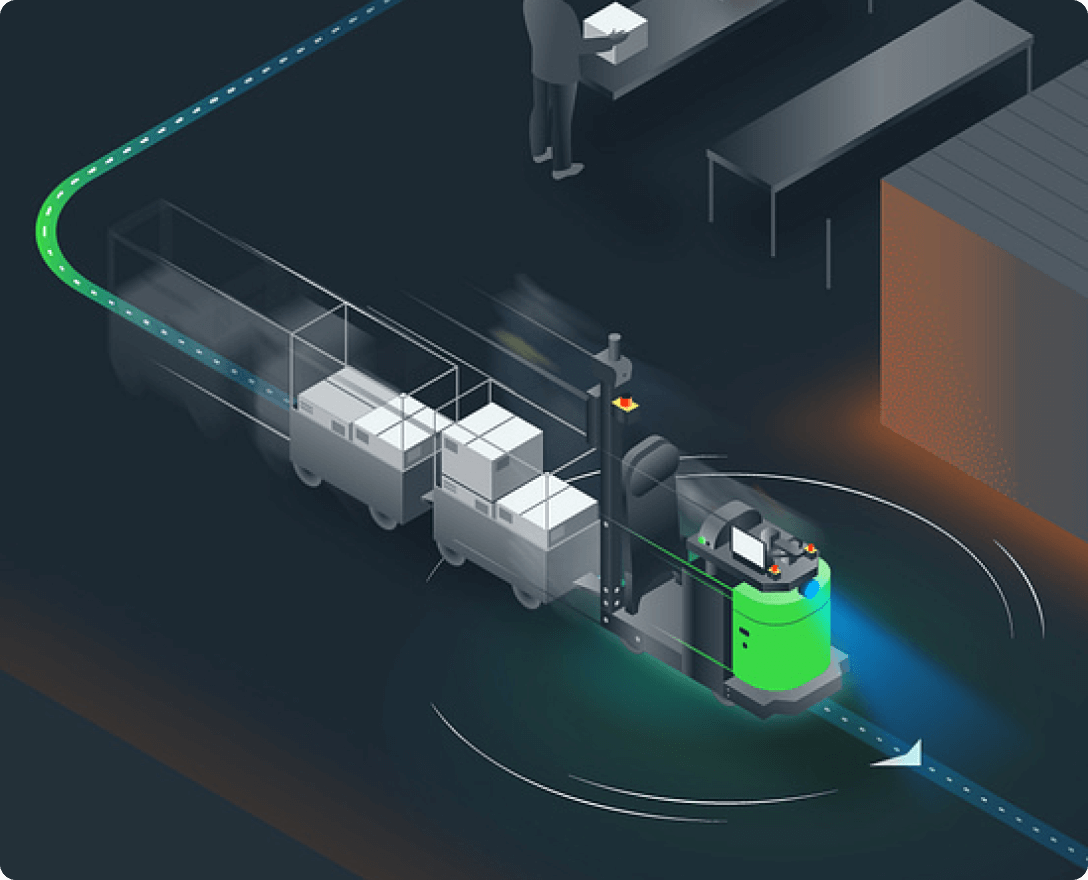
Autonomous Mobile Robots (AMRs) navigate dynamically through a warehouse using onboard intelligence, sensors, and real-time mapping. Unlike fixed-path systems, AMRs can adapt to changing conditions, reroute around obstacles, and operate alongside people. AMRs are commonly used for material transport, picking support, pallet movement, and dynamic workflows.
Best suited for:
- rapidly changing environments
- operations with variable demand
- facilities prioritizing flexibility and scalability
What are AGVs?
Automated Guided Vehicles (AGVs) move materials along predefined routes using fixed guidance systems such as tape, reflectors, wires, or markers. AGVs are highly effective in structured, repetitive workflows where routes and tasks remain consistent. AGVs are commonly used for repetitive transport tasks, point-to-point movement, manufacturing workflows, and predictable environments.
Best suited for:
- stable workflows
- highly standardized operations
- environments with minimal variability
What is AS/RS?
Automated Storage and Retrieval Systems (AS/RS) are automated systems designed to store and retrieve inventory with high speed and density. These systems often use cranes, shuttles, lifts, or robotic mechanisms to move inventory within structured storage environments. AS/RS systems are commonly used for high-density storage, goods-to-person fulfillment, inventory buffering, and high-throughput order fulfillment.
Best suited for:
- operations constrained by space
- high-volume fulfillment environments
- facilities requiring dense inventory storage
The Core Difference: Flexibility vs Structure
The biggest difference between these systems is not the hardware. It’s how they handle change.
AMRs prioritize adaptability
AMRs are designed for environments where workflows evolve, priorities shift in real time, and layout that may change over time. Because they navigate dynamically, they can adapt without requiring extensive infrastructure modifications.
AGVs prioritize consistency
AGVs perform best in environments where routes are fixed, processes are highly repeatable, and operational variability is low. Their structured nature creates predictability, but can limit flexibility when workflows change.
AS/RS prioritizes density and throughput
AS/RS systems are optimized for maximizing storage efficiency, increasing retrieval speed, and reducing manual handling. They deliver significant value in high-volume environments, but often require substantial infrastructure investment and long-term facility planning.
Comparing AMRs, AGVs, and AS/RS
| Capability | AMRs | AGVs | AS/RS |
|---|---|---|---|
| Flexibility | High | Low–Moderate | Low |
| Infrastructure requirements | Minimal | Moderate–High | High |
| Scalability | High | Moderate | Moderate |
| Adaptability to workflow changes | High | Low | Low |
| Best for dynamic operations | Yes | Limited | Limited |
| Storage density optimization | Limited | Limited | Excellent |
| Implementation complexity | Moderate | Moderate | High |
| Typical deployment speed | Faster | Moderate | Longer-term |
| Human collaboration | Strong | Moderate | Limited |
Which System Is Right for Your Operation?
The right choice depends less on the technology itself and more on the operational goals.
Choose AMRs if your operation needs:
- flexibility
- scalability
- rapid deployment
- dynamic workflow adaptation
- support for variable demand
AMRs are often the strongest fit for operations where change is constant.
Choose AGVs if your operation needs:
- predictable material movement
- repetitive workflows
- structured routing
- highly standardized processes
AGVs perform well in environments where consistency matters more than adaptability.
Choose AS/RS if your operation needs:
- high-density storage
- goods-to-person fulfillment
- space optimization
- high-volume inventory handling
AS/RS systems are most effective when storage efficiency and throughput are the primary constraints.
The Real-World Reality: Most Operations Need More Than One System
In practice, modern warehouse operations rarely rely on a single automation technology. A facility may use AS/RS for storage, AMRs for transport, conveyors for movement between zones, and people for exception handling and flexible tasks. The challenge is no longer choosing one system. It’s coordinating all of them.
Why Orchestration Matters
As warehouses become more automated, operational performance depends less on individual systems and more on how those systems work together. Without coordination, bottlenecks shift between systems, resources become underutilized, manual intervention increases, and workflows become fragmented. This is where orchestration becomes critical.
Orchestration coordinates people, robots, systems, and infrastructure in real time to ensure work flows efficiently across the operation. Instead of optimizing isolated tasks, orchestration optimizes the movement of work across the entire environment.
The Future of Warehouse Automation
The future of warehouse automation is not about one technology replacing another. It’s about creating interconnected environments where multiple systems coordinate dynamically. Operations are increasingly moving toward:
- mixed automation environments
- multi-vendor robot ecosystems
- real-time workflow coordination
- facility-level orchestration across systems and infrastructure
The organizations that succeed will not simply deploy more automation. They will build operations capable of adapting continuously as conditions change.
Common Mistakes to Avoid
Choosing technology before defining operational goals
Automation should solve operational constraints—not follow industry trends.
Prioritizing hardware over workflow design
Technology alone does not create efficiency. Workflow design matters just as much.
Underestimating integration requirements
The more systems deployed, the more coordination becomes necessary.
Designing for today’s workflows only
Operations evolve. Automation strategies should be flexible enough to evolve with them.
Conclusion
AMRs, AGVs, and AS/RS systems each play an important role in warehouse automation. The best choice depends on the operation, the workflows, and the long-term goals. But as automation environments become more complex, the real differentiator is no longer the individual systems themselves. It’s the ability to coordinate them. Because in modern warehouse operations, performance doesn’t come from deploying more technology. It comes from making everything work together.