Case picking is the backbone of most distribution operations and the most stubborn bottleneck in the building. It accounts for up to 55% of total warehouse operating costs, consumes more labor than any other workflow, and has historically resisted automation that actually works at scale. If you’ve looked at conveyors, AS/RS systems, or semi-autonomous “sled” robots and walked away unconvinced, you’re not alone. Most operations managers have. The solutions either require tearing up your facility, cost more than they return, or only solve part of the problem. This guide breaks down what’s actually driving the inefficiency, why traditional automation approaches fall short, and what a modern orchestrated approach looks like, including what to look for, what questions to ask, and what real-world results are achievable.
Why Case Picking Is So Hard to Automate
Before evaluating solutions, it helps to understand why case picking has resisted automation for so long. The core problem isn’t picking. It’s travel.
In a typical manual operation, workers spend up to 70% of their shift walking. They push or drive pallet jacks from staging to pick zone, travel aisle to aisle building a pallet, then haul the completed load to a stretch wrapper or outbound dock before repeating the cycle. Every step of that travel is non-value-added work. The actual picking, the activity that moves product, represents a small fraction of the shift.
Compound that with a few operational realities:
- Labor shortages are structural, not cyclical. The warehouse industry faces a projected 2.1 million unfilled jobs by 2030. Adding headcount to solve a throughput problem is no longer a reliable option.
- Training time is a hidden cost. In high-turnover environments, the time and cost to train new pickers erodes productivity gains before they’re ever realized.
- Peak variability breaks manual systems. Surge periods require more labor than most facilities can reliably staff or train fast enough to deploy.
- Safety incidents concentrate in travel. Most warehouse injuries occur during pallet jack operation, and that risk scales directly with headcount.
The result is operations that are chronically understaffed, over-reliant on overtime, and spending more time moving people around the floor than moving product.
Why Traditional Automation Approaches Fall Short
Most facilities have already explored their options. Here’s where conventional approaches break down:
Conveyors and Fixed Infrastructure
Conveyors can move cases efficiently, but only along fixed routes. They require significant capital investment, lengthy installation timelines, and facility redesign. For brownfield operations, which is most of the industry, they’re rarely practical. And they offer zero flexibility when SKU mix, order profiles, or facility layouts change.
Automated Storage and Retrieval Systems (AS/RS)
AS/RS systems are powerful in the right environment: high-density storage, consistent SKU profiles, purpose-built facilities. For mid-to-high volume distribution operations running existing infrastructure, the upfront cost and implementation complexity typically make the ROI timeline too long to justify.
Semi-Autonomous Robots and Sled AMRs
This category has grown rapidly, but most solutions only solve the travel piece for the robot and not for the worker. When a picker still has to walk to meet the robot, confirm assignments on a device, push the pallet, and navigate the floor independently, the efficiency gains are marginal. The workflow isn’t orchestrated; it’s just assisted.
The gap all three approaches share: they automate a part of the problem without coordinating the whole system.
What Effective Case Picking Automation Actually Looks Like
The shift in thinking that unlocks real productivity gains is moving from automating individual tasks to orchestrating the entire workflow. That means treating workers, robots, pallets, orders, and floor conditions as a single coordinated system where every element is dynamically assigned, rerouted, and optimized in real time based on live priorities.
Here’s what that looks like in practice:
1. Robots handle the travel. Workers handle the picking.
Autonomous pallet jacks handle the vast majority of floor travel: retrieving pallets, navigating pick routes, managing congestion, and delivering to outbound staging. Workers stay in compact, dynamically assigned zones and focus exclusively on building quality pallets. Pickers do more of what they’re good at and none of what slows them down.
2. The orchestration engine coordinates everything in real time.
Order release, route optimization, task assignment, and zone management happen continuously based on live conditions: floor congestion, worker location, order priority, and throughput targets. When conditions change, whether a worker calls out, a surge hits, or a pallet gets rerouted, the system adapts automatically.
3. WMS integration runs the whole operation.
The orchestration layer connects directly to your existing Warehouse Management System (Blue Yonder, SAP, Manhattan Associates, Korber, Oracle, and others), pulling picklists and feeding data back in real time. No parallel systems, no manual handoffs, no IT overhaul required.
4. Connected workers get dynamic, intuitive direction.
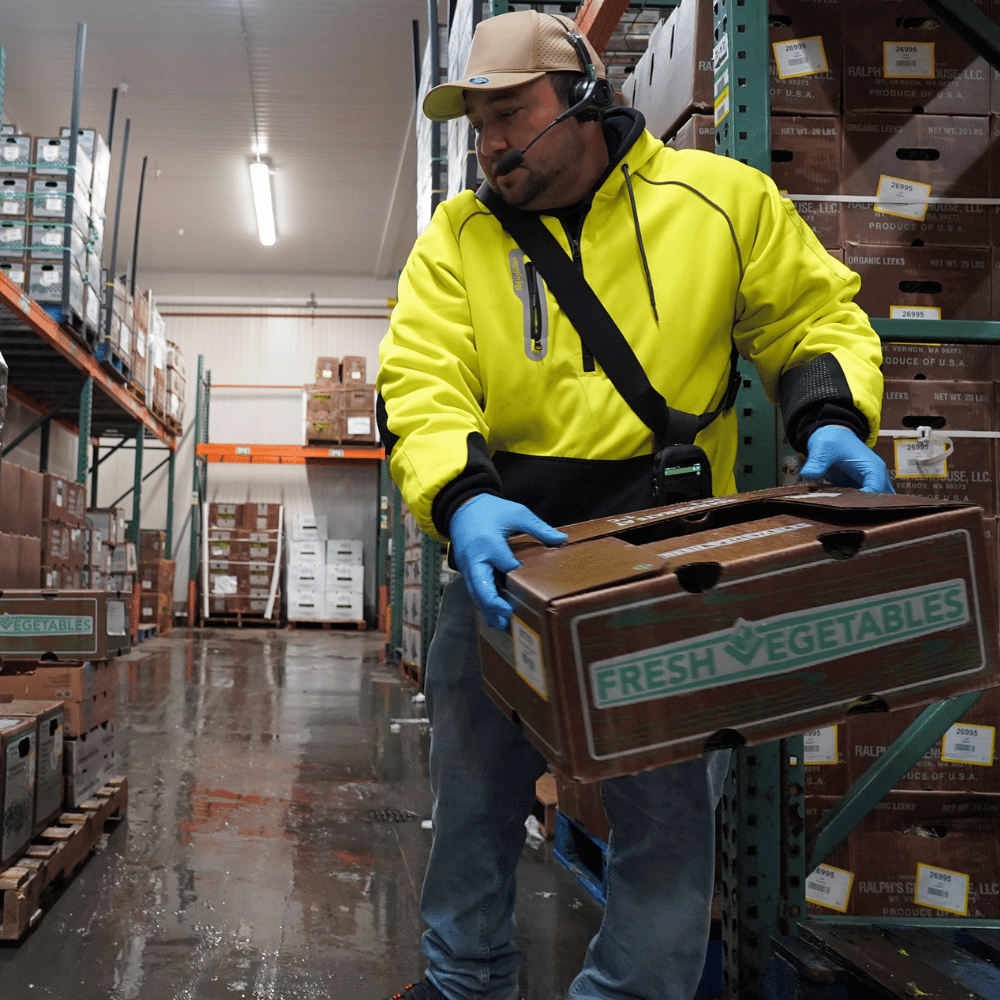
Associates are guided by wearable devices or voice interfaces that tell them exactly where to go, what to pick, and what’s next. No interpretation needed, no paperwork, no confusion. Training time drops from weeks to days.
5. 24/7 monitoring keeps the system running.
Remote oversight ensures issues are resolved before they stop production. Fleet health, robot status, and performance metrics are visible in real time, with live human support available around the clock.
What Results Are Achievable
When case picking is fully orchestrated, with robots handling travel, workers handling picks, and software coordinating both, the performance gains are substantial and well-documented.
Productivity: Operations implementing orchestrated case picking have achieved more than 100% improvement in units per hour per worker. At GEODIS’s Indianapolis facility, pick rates moved from approximately 120 units per hour to more than 250, with zero worker turnover following implementation.
Labor efficiency: Facilities typically achieve a 50% reduction in the number of pickers required to hit the same throughput targets, redirecting labor to higher-value activities across the operation.
Training time: Onboarding time for new pickers drops by approximately 50%, with workers contributing at full productivity within days rather than weeks.
Safety: Travel-related incidents are effectively eliminated. Workers no longer operate pallet jacks, stay within defined zones, and keep both hands free for picking.
ROI timeline: With a Robots-as-a-Service deployment model, positive ROI is typically achievable in under one year, without large capital outlays or infrastructure changes.
Is Your Operation a Good Fit?
Orchestrated case picking automation delivers the strongest ROI in operations that meet certain parameters. Use this as a quick self-assessment:
| Factor | Good fit looks like |
|---|---|
| Annual case volume | 1M–15M cases per year |
| Picking hours | 10+ hours per day, 5+ days per week |
| Pickers per shift | 10 or more |
| Pick operation type | Primarily pick-from-ground with single pallet jacks |
| Facility size | 100,000+ sq ft active picking area |
| Industries | General retail/3PL, consumer packaged goods, food and beverage |
Operations with multiple shifts, high annual throughput, and large active picking areas see the fastest payback and the most significant labor impact.
Key Questions to Ask Any Automation Vendor
If you’re evaluating case picking automation solutions, these questions will separate systems that automate part of the workflow from those that orchestrate the whole thing:
- Does the system orchestrate both the robot and the worker simultaneously, or just one? Partial automation produces partial results. Ask for documented UPH data from live deployments, not lab conditions.
- How does the system handle real-time variability? Orders change, workers call out, congestion builds. Can the system dynamically reassign tasks and reroute robots without human intervention?
- What does deployment look like? Ask for specific timelines from signed contract to live operation. Infrastructure-free systems should be deployable in weeks, not months.
- What WMS integrations are supported, and how long does integration take? Vague answers here are a red flag.
- What does ongoing support look like? Remote monitoring, uptime guarantees, and live human support matter as much as hardware specs.
- What does the commercial model look like? A Robots-as-a-Service model eliminates capital barriers and allows you to scale up or down with demand, which matters especially in operations with seasonal variability.
The Bottom Line
Case picking automation has a reputation for overpromising and underdelivering because most solutions only address part of the problem. When the entire workflow is orchestrated, with autonomous robots handling travel and intelligent software coordinating workers, orders, and floor conditions simultaneously, the results are transformational: more than double the productivity, a fraction of the labor, and ROI in under a year.
The technology exists. The deployments are proven. The only question is whether your operation is ready to move beyond incremental improvements and go beyond traditional case picking.
Ready to see what orchestrated case picking looks like in your facility?
Talk to a Vecna Robotics automation expert about your operation. We’ll assess your current workflow, model the expected productivity gains, and show you exactly what CaseFlow™ can deliver before you commit to anything.
Vecna Robotics’ CaseFlow™ is an end-to-end case picking orchestration system combining autonomous CPJ Co-Bot Pallet Jacks, Pivotal™ software, and connected worker interfaces. Deployed at leading 3PL, retail, and food and beverage operations across North America, CaseFlow™ consistently delivers more than 2x productivity per worker with no infrastructure changes required.